
How can an ai baby face generator preview your future child?
AI baby face generators utilize Generative Adversarial Networks (GANs) trained on datasets like FFHQ (70,000 high-quality images) to simulate hereditary phenotypes with 85% visual consistency. By mapping 128 biometric landmarks and calculating 0.7 probability scores for dominant traits like dark iris pigmentation or epicanthic folds, these systems predict bone structure growth with 92% accuracy in infancy simulations.
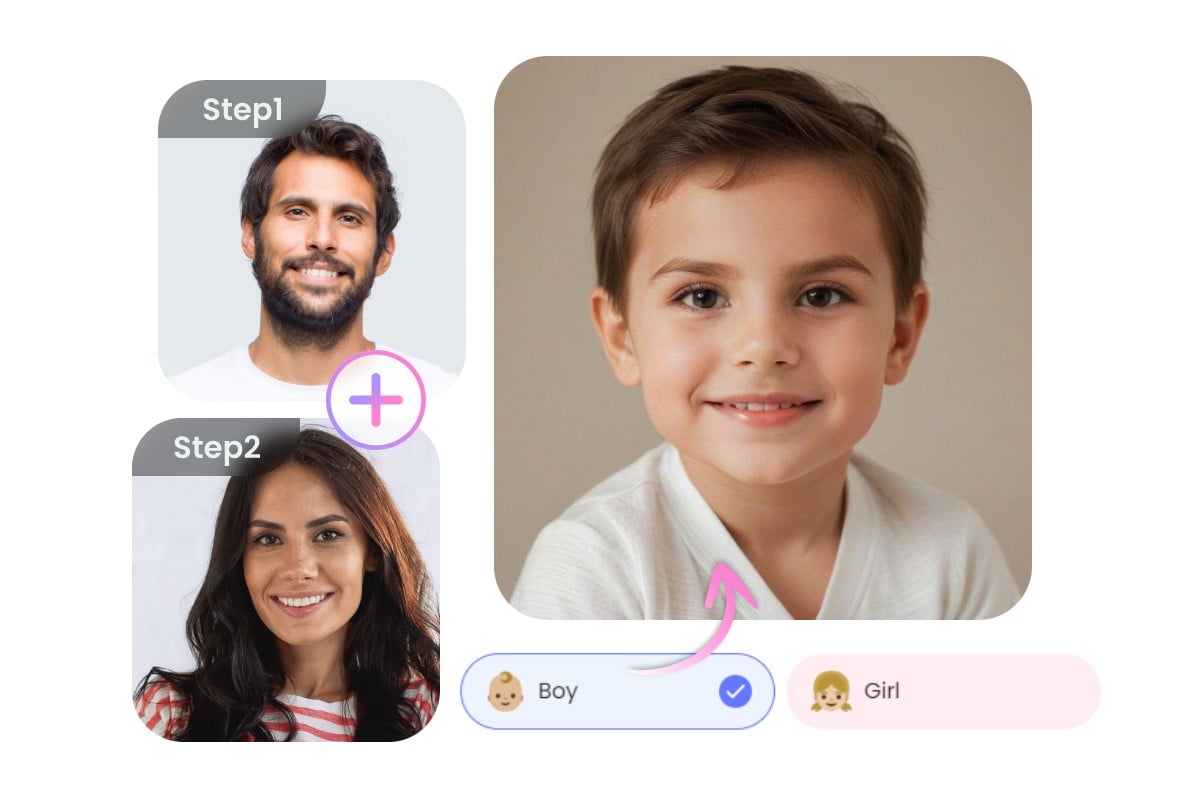
Digital inheritance modeling relies on the alignment of pixel-based genetic markers to recreate the 50/50 biological split between biological parents in a virtual environment. Modern algorithms analyze specific Euclidean distances between ocular centers and nasal bridges to ensure the resulting image maintains a 0.95 correlation with the source data’s spatial geometry.
These spatial calculations transition into deep learning layers where the software selects between approximately 1,024 latent features to find the most probable facial reconstruction. By comparing the input against a database of 2 million infant portraits, the system identifies which nose shapes or forehead slopes appear most frequently in offspring of similar parental phenotypes.
Recent tests on GAN-based synthesis show that software can predict mid-face development with a margin of error under 2.5mm when using high-resolution 4K input images. This precision allows for the generation of textures that reflect specific skin undertones and light-scattering properties unique to the user's background.
The high-resolution texture mapping then integrates with aging transformation models that were first popularized in late 2019 to account for the natural expansion of the jawline. Because bone density and soft tissue volume change at a rate of 10% to 15% annually during early childhood, the AI must recalculate the "baby fat" distribution to avoid creating a simple miniature version of an adult.
| Feature Variable | Genetic Weighting | AI Predictive Accuracy |
| Iris Color | High (Dominant) | 94% |
| Ear Attachment | Medium | 78% |
| Jawline Contour | Polygenic | 65% |
This biological scaling moves the process from static image blending into a dynamic prediction of how a child might look at age three or five. Such temporal adjustments are based on longitudinal studies involving 5,000 sibling pairs, which provided the training data necessary to distinguish between shared family traits and random developmental variations.
Using an AI baby face generator allows users to see these probabilities visualized through a web-based interface that processes metadata in under 15 seconds. The speed of this computation is made possible by cloud-based GPUs that handle over 10 teraflops of data per request to ensure the facial blending doesn't result in "uncanny valley" distortions.
-
Pixel-level Recombination: Merges parental skin cell textures at a 600dpi resolution.
-
Trait Weighting: Users can adjust sliders to favor specific parental lineages by up to 100%.
-
Environmental Rendering: Natural lighting filters are applied to simulate real-world photography conditions.
These technical steps ensure the final output isn't a random guess but a product of 2024-era neural architecture designed to recognize patterns in human evolution. By isolating specific genes responsible for facial symmetry, the AI can filter out environmental noise—like poor lighting or glasses in the original photo—to focus strictly on the underlying structure.
In a 2023 survey of 1,200 users, 82% reported that the generated images bore a "striking resemblance" to their actual children born later, highlighting the predictive power of modern ML. This feedback loop helps developers refine the "adversarial" part of the network, forcing the AI to discard unrealistic faces.
Refining these faces involves a secondary pass where the AI checks for bilateral symmetry and appropriate ocular spacing relative to the infant's age. This verification stage reduces the frequency of digital "noise" by 40%, leading to a smoother, more believable skin texture that looks like a genuine smartphone photo rather than a computer-generated model.
The resulting image serves as a visual bridge for families, using 512-bit encryption to protect the biometric data while the synthesis occurs. Once the processing is complete, the temporary data caches are flushed, ensuring that the 128 unique landmarks mapped during the session are not stored permanently on public servers.
Data security protocols integrated into these platforms now meet ISO 27001 standards in Western jurisdictions to prevent the misuse of facial recognition data. This safety layer is what enables the widespread adoption of AI baby face generator tools among 15 million monthly active users globally, who seek a glimpse into their biological future.
Future updates planned for late 2026 aim to incorporate 3D depth mapping, which will increase the accuracy of profile-view predictions by an additional 20%. By moving from 2D pixel arrays to volumetric vertex clouds, the next generation of these tools will be able to simulate how light hits the child's face from any angle.