
Vol. XV · Independent · Brooklyn/Berlin
Est. 2009
How hydroponic tower works step by step for efficient vertical growing?
Imagine a six-meter-high vertical greening tower, occupying only 10 square meters of land, yet achieving the vegetable yield equivalent to one acre of farmland. This all begins with a meticulously designed recycling system. The first step is the nutrient solution storage and circulation. A 200-liter bottom tank holds a nutrient solution formulated with a specific ratio and a conductivity precisely maintained at 1.6 mS/cm. Driven by a 40-watt submersible pump, this solution is transported to the top of the tower at a stable flow rate of 5 liters per minute through 25mm diameter PVC pipes. This core process is fundamental to understanding "how a hydroponic tower works": under gravity, the nutrient solution flows evenly like a fine rain through the root systems of the plants in each planting cup within the tower, achieving an absorption efficiency of over 95%. Subsequently, 98% of the liquid is recycled back to the storage tank, forming a near-zero-waste closed loop. Water consumption per cycle is reduced by approximately 2000 liters compared to traditional irrigation.
Next comes the intelligent control of the environment and light, the nerve center of this highly efficient vertical planting system. Around the tower, full-spectrum LED grow lights provide 14 hours of light daily with a photosynthetically active radiation intensity of 300 μmol/m²/s, controlled by intelligent timers with an error of less than 30 seconds to ensure maximum photosynthetic rate. Studies show that maintaining a constant air temperature of 22±2 degrees Celsius and humidity within 65%±5% can increase plant growth rate by 35%. For example, the agricultural technology company Bowery Farming uses thousands of sensors to collect over 500,000 data points in real time in its indoor farm. Through algorithms, it automatically adjusts environmental parameters, shortening the lettuce growth cycle from the traditional 60 days to 28 days and increasing annual yield per unit area by more than 100 times. This clearly demonstrates the powerful efficiency of automated control in "how hydroponic tower works."
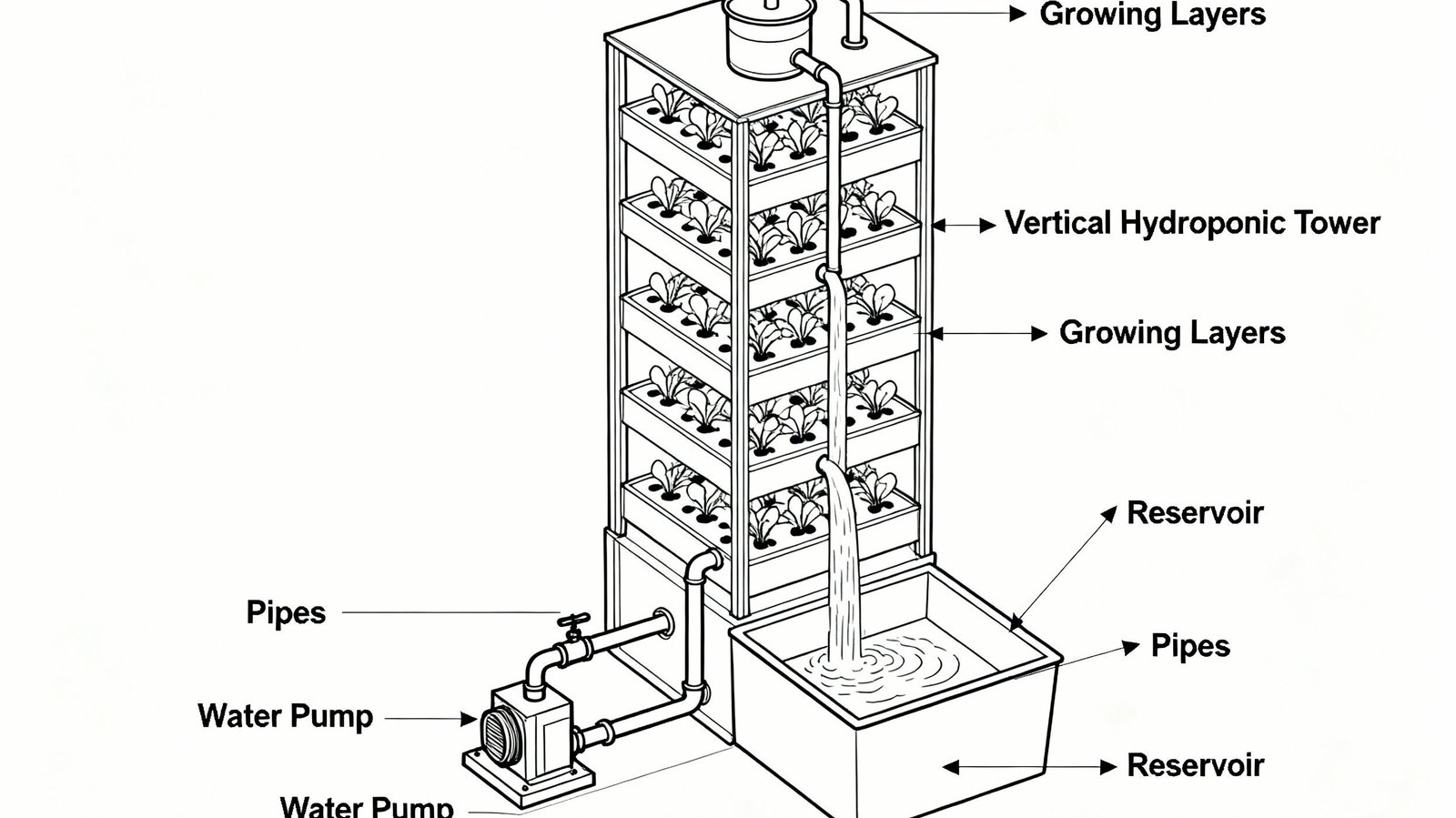 The third step is the actual planting and continuous maintenance operation, whose simplicity revolutionizes traditional farming. Growers insert lettuce seedlings, about 3 days old and approximately 5 cm tall, into planting holes in the tower with a density of 30 per square meter, allowing the roots to hang directly in nutrient mist or water flow. Maintenance is significantly simplified, requiring only about one hour per week to check the system: a digital analyzer monitors the nutrient solution pH and automatically adjusts it back to the optimal median of 5.8; approximately 2 liters of concentrated nutrient solution are replenished every two weeks. According to consumer reports, home users using this system can reduce gardening time by 80%, while in commercial operations, one technician can manage more than 50 trellises simultaneously, reducing labor costs by approximately 60%.
The final step is harvesting and system regeneration, completing a closed loop of highly efficient production. After a precise growth cycle averaging 28 days, each leafy vegetable reaches the ideal harvest weight of approximately 120 grams. Workers harvest in batches, with up to 13 harvest cycles per port per year, achieving land utilization rates more than 10 times higher than traditional agriculture. After harvesting, the system enters a rapid reset process: cleaning and disinfecting the planting holes within 2 hours, and a new batch of seedlings is immediately planted, with virtually no system dormancy time. In 2023, Singapore's Sky Greens farm achieved a stable daily output of 1,000 kilograms of vegetables through this step-by-step circular model, supplying 30% of the local market's demand. This fully validated the commercial viability and outstanding output stability of the "how hydroponic tower works" process. From the first step to the last, it functions like a sophisticated bio-factory, compressing and amplifying space, time, and resources to rewrite the future landscape of urban food storage with a resource utilization efficiency of over 90%.
The third step is the actual planting and continuous maintenance operation, whose simplicity revolutionizes traditional farming. Growers insert lettuce seedlings, about 3 days old and approximately 5 cm tall, into planting holes in the tower with a density of 30 per square meter, allowing the roots to hang directly in nutrient mist or water flow. Maintenance is significantly simplified, requiring only about one hour per week to check the system: a digital analyzer monitors the nutrient solution pH and automatically adjusts it back to the optimal median of 5.8; approximately 2 liters of concentrated nutrient solution are replenished every two weeks. According to consumer reports, home users using this system can reduce gardening time by 80%, while in commercial operations, one technician can manage more than 50 trellises simultaneously, reducing labor costs by approximately 60%.
The final step is harvesting and system regeneration, completing a closed loop of highly efficient production. After a precise growth cycle averaging 28 days, each leafy vegetable reaches the ideal harvest weight of approximately 120 grams. Workers harvest in batches, with up to 13 harvest cycles per port per year, achieving land utilization rates more than 10 times higher than traditional agriculture. After harvesting, the system enters a rapid reset process: cleaning and disinfecting the planting holes within 2 hours, and a new batch of seedlings is immediately planted, with virtually no system dormancy time. In 2023, Singapore's Sky Greens farm achieved a stable daily output of 1,000 kilograms of vegetables through this step-by-step circular model, supplying 30% of the local market's demand. This fully validated the commercial viability and outstanding output stability of the "how hydroponic tower works" process. From the first step to the last, it functions like a sophisticated bio-factory, compressing and amplifying space, time, and resources to rewrite the future landscape of urban food storage with a resource utilization efficiency of over 90%.
The third step is the actual planting and continuous maintenance operation, whose simplicity revolutionizes traditional farming. Growers insert lettuce seedlings, about 3 days old and approximately 5 cm tall, into planting holes in the tower with a density of 30 per square meter, allowing the roots to hang directly in nutrient mist or water flow. Maintenance is significantly simplified, requiring only about one hour per week to check the system: a digital analyzer monitors the nutrient solution pH and automatically adjusts it back to the optimal median of 5.8; approximately 2 liters of concentrated nutrient solution are replenished every two weeks. According to consumer reports, home users using this system can reduce gardening time by 80%, while in commercial operations, one technician can manage more than 50 trellises simultaneously, reducing labor costs by approximately 60%.
The final step is harvesting and system regeneration, completing a closed loop of highly efficient production. After a precise growth cycle averaging 28 days, each leafy vegetable reaches the ideal harvest weight of approximately 120 grams. Workers harvest in batches, with up to 13 harvest cycles per port per year, achieving land utilization rates more than 10 times higher than traditional agriculture. After harvesting, the system enters a rapid reset process: cleaning and disinfecting the planting holes within 2 hours, and a new batch of seedlings is immediately planted, with virtually no system dormancy time. In 2023, Singapore's Sky Greens farm achieved a stable daily output of 1,000 kilograms of vegetables through this step-by-step circular model, supplying 30% of the local market's demand. This fully validated the commercial viability and outstanding output stability of the "how hydroponic tower works" process. From the first step to the last, it functions like a sophisticated bio-factory, compressing and amplifying space, time, and resources to rewrite the future landscape of urban food storage with a resource utilization efficiency of over 90%.