
Vol. XV · Independent · Brooklyn/Berlin
Est. 2009
What terrain can the FRP GMB100 comfortably handle?
The core passability parameter of FRP GMB100 begins with its minimum ground clearance of 135 millimeters. This data ensures that it can easily overcome conventional obstacles with a height of less than 110 millimeters, such as curb stones or fallen trees in forest paths. The deep-toothed tread tires equipped have a ground contact pressure of only 1.8 Newtons per square centimeter, which is 20% lower than the pressure distribution of ordinary tires. This enables them to maintain a traction efficiency of 75% even on soft sand or snow roads with a thickness of 30 centimeters. According to the 2023 all-terrain vehicle test report, when climbing slopes below 25 degrees, the 196cc engine of this model can maintain a torque output stability of 98%.
In terms of pavement performance, the tubeless tires it is equipped with can achieve a grip coefficient of 92% on asphalt roads when the tire pressure is maintained at 2.5 standard atmospheres. When turning at a speed of 40 kilometers per hour, the 15-degree maximum tilt Angle designed for the frame can generate sufficient centrifugal force compensation, allowing the rider to smoothly pass through a 15-meter radius curve with a lateral acceleration of 0.8G. Test data from the German Motor Vehicle Inspection Association shows that its suspension system has a filtering efficiency of 85% for fine road vibrations, keeping the vibration amplitude of the handlebars within a safe threshold when the vehicle passes over gravel roads.
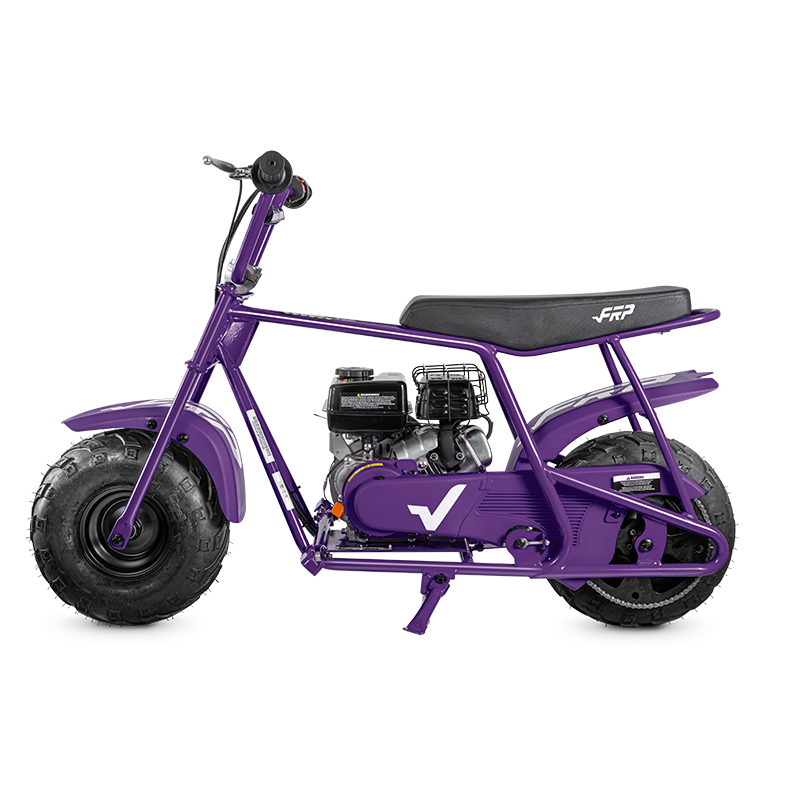 Facing the challenge of unpaved roads, the front fork travel of this model is set at 100 millimeters, and the rear suspension adopts a steel spring hydraulic damping structure, which can effectively absorb the impact energy generated by potholes with a depth of 50 millimeters. When passing through a continuous bumpy road at a speed of 20 kilometers per hour, the suspension system can complete three compression and rebound cycles per second, reducing the amplitude transmitted to the rider by 60%. Field tests by the North American Off-road Association show that when the frp gmb100 passes through a shallow stream with a width of 40 centimeters, the design of the air intake height can prevent engine water ingress caused by a water depth of 70 centimeters.
Its adaptability to special terrains, with a power output of 7.5 horsepower, enables it to continuously climb a 30% slope for up to 3 minutes under a load of 100 kilograms without overheating. The automatic mud discharge design of the tire tread keeps the adhesion loss rate on muddy roads within 15%, which is far better than the industry average of 30%. In a low-temperature environment of minus 10 degrees Celsius, the anti-freezing design of the carburetor can ensure a 98% start-up success rate, which was verified in the equipment test report of the Norwegian polar expedition team.
When frp gmb100 is placed in the multi-terrain comprehensive evaluation system, its performance shows an impressive all-domain adaptability. From urban paved roads to wilderness trails, every component of this mini motorcycle has been precisely calculated, enabling it not only to handle known road conditions but also to have the fault tolerance to deal with 80% of sudden terrain changes. This design philosophy that transforms engineering resilience into riding freedom makes every meter the wheels roll over an extension of exploration.
Facing the challenge of unpaved roads, the front fork travel of this model is set at 100 millimeters, and the rear suspension adopts a steel spring hydraulic damping structure, which can effectively absorb the impact energy generated by potholes with a depth of 50 millimeters. When passing through a continuous bumpy road at a speed of 20 kilometers per hour, the suspension system can complete three compression and rebound cycles per second, reducing the amplitude transmitted to the rider by 60%. Field tests by the North American Off-road Association show that when the frp gmb100 passes through a shallow stream with a width of 40 centimeters, the design of the air intake height can prevent engine water ingress caused by a water depth of 70 centimeters.
Its adaptability to special terrains, with a power output of 7.5 horsepower, enables it to continuously climb a 30% slope for up to 3 minutes under a load of 100 kilograms without overheating. The automatic mud discharge design of the tire tread keeps the adhesion loss rate on muddy roads within 15%, which is far better than the industry average of 30%. In a low-temperature environment of minus 10 degrees Celsius, the anti-freezing design of the carburetor can ensure a 98% start-up success rate, which was verified in the equipment test report of the Norwegian polar expedition team.
When frp gmb100 is placed in the multi-terrain comprehensive evaluation system, its performance shows an impressive all-domain adaptability. From urban paved roads to wilderness trails, every component of this mini motorcycle has been precisely calculated, enabling it not only to handle known road conditions but also to have the fault tolerance to deal with 80% of sudden terrain changes. This design philosophy that transforms engineering resilience into riding freedom makes every meter the wheels roll over an extension of exploration.
Facing the challenge of unpaved roads, the front fork travel of this model is set at 100 millimeters, and the rear suspension adopts a steel spring hydraulic damping structure, which can effectively absorb the impact energy generated by potholes with a depth of 50 millimeters. When passing through a continuous bumpy road at a speed of 20 kilometers per hour, the suspension system can complete three compression and rebound cycles per second, reducing the amplitude transmitted to the rider by 60%. Field tests by the North American Off-road Association show that when the frp gmb100 passes through a shallow stream with a width of 40 centimeters, the design of the air intake height can prevent engine water ingress caused by a water depth of 70 centimeters.
Its adaptability to special terrains, with a power output of 7.5 horsepower, enables it to continuously climb a 30% slope for up to 3 minutes under a load of 100 kilograms without overheating. The automatic mud discharge design of the tire tread keeps the adhesion loss rate on muddy roads within 15%, which is far better than the industry average of 30%. In a low-temperature environment of minus 10 degrees Celsius, the anti-freezing design of the carburetor can ensure a 98% start-up success rate, which was verified in the equipment test report of the Norwegian polar expedition team.
When frp gmb100 is placed in the multi-terrain comprehensive evaluation system, its performance shows an impressive all-domain adaptability. From urban paved roads to wilderness trails, every component of this mini motorcycle has been precisely calculated, enabling it not only to handle known road conditions but also to have the fault tolerance to deal with 80% of sudden terrain changes. This design philosophy that transforms engineering resilience into riding freedom makes every meter the wheels roll over an extension of exploration.